Video walkthrough
Why I made it
I took a gamification workshop with Marie-Jo Leroux, a former videogame producer who teaches learning designers how to use real game design in their courses. Her YouTube video showed an example of a connection game built in Storyline. I do not work in Storyline, so the video gave me the idea and her workshop worksheet gave me the framework I built from. I wanted to try the framework on content I am already super familiar with rather than spend time learning new material, so I used AP Precalculus. My students had already been introduced to limits, but knowing a concept and connecting it to everything else are different skills. A student might recognize a vertical asymptote in a function and still not connect it to the limit notation that describes it. Those connections are what this game practices.
What it is
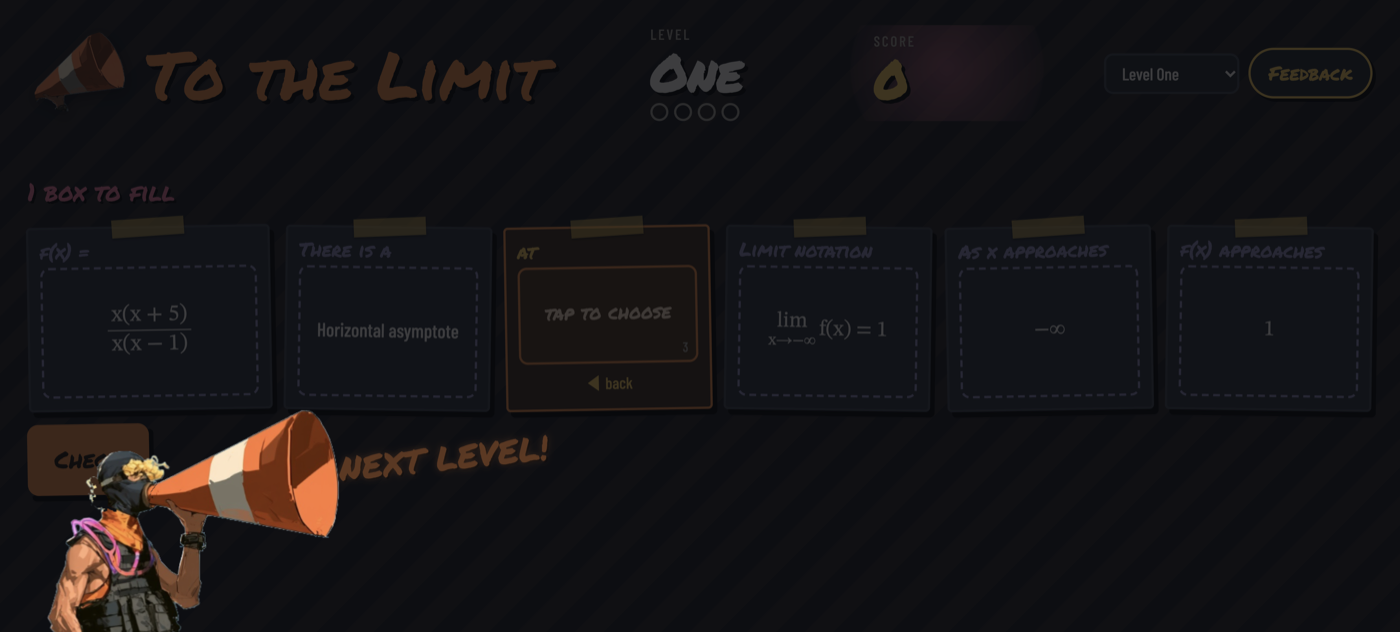
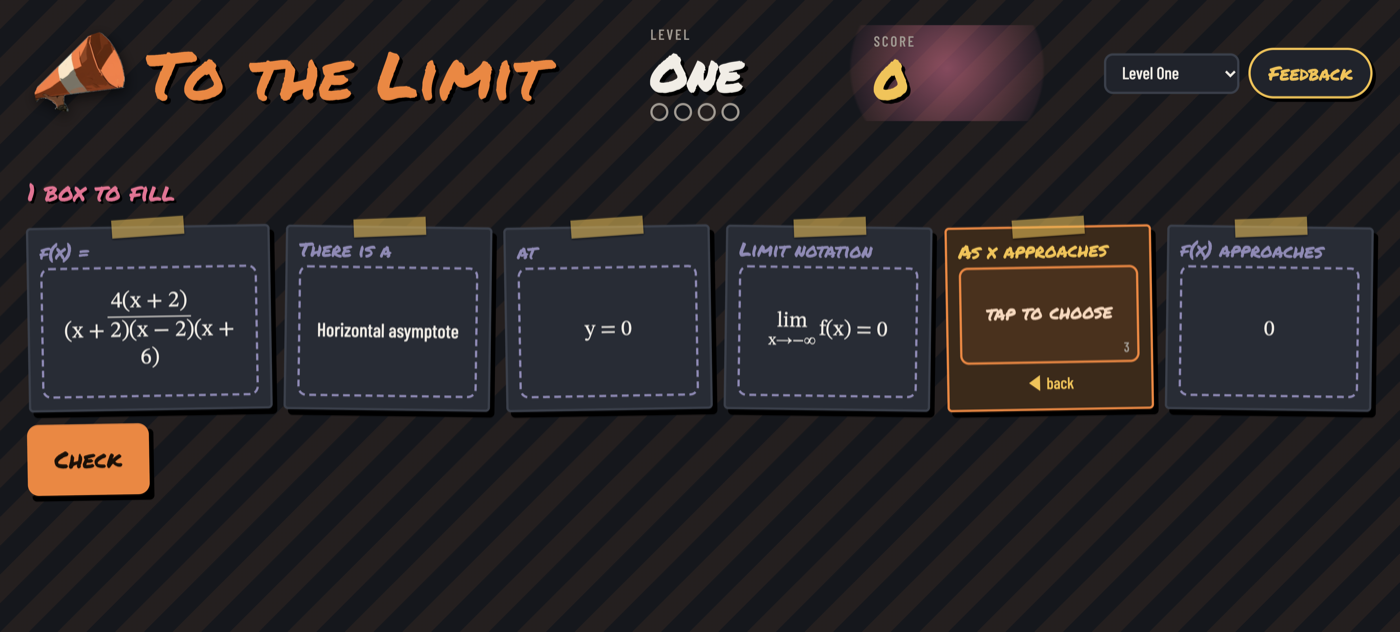
To the Limit is a replayable web game. Each round shows a rational function, and the student builds a true statement about it by tapping through choices in a row of boxes: there is a [property] at [location], then the matching limit notation. The properties are horizontal asymptotes, vertical asymptotes, slant asymptotes, and holes. There are five levels. On Level One, most of the row is already filled in, and the player only needs to find the answer for one box. Each level opens more boxes until the final challenge, where every box is empty and the game only says right or wrong. To move up a level, a student has to get four rounds right on the first check, and the scoring gives the most points for first-check answers. A mascot announces each level through his traffic cone. I made him in Midjourney, inspired by a student of mine who runs the student section at our sports events. One of the fun things about creating your own game is that you can personalize it to something that connects directly with your users. A character inspired by someone the students recognize adds a little extra fun for them. Students reach the game through Canvas, anonymously: it sends back a best score but no names, and it is not counted toward their grade. The game is live, and you can play it in your browser.
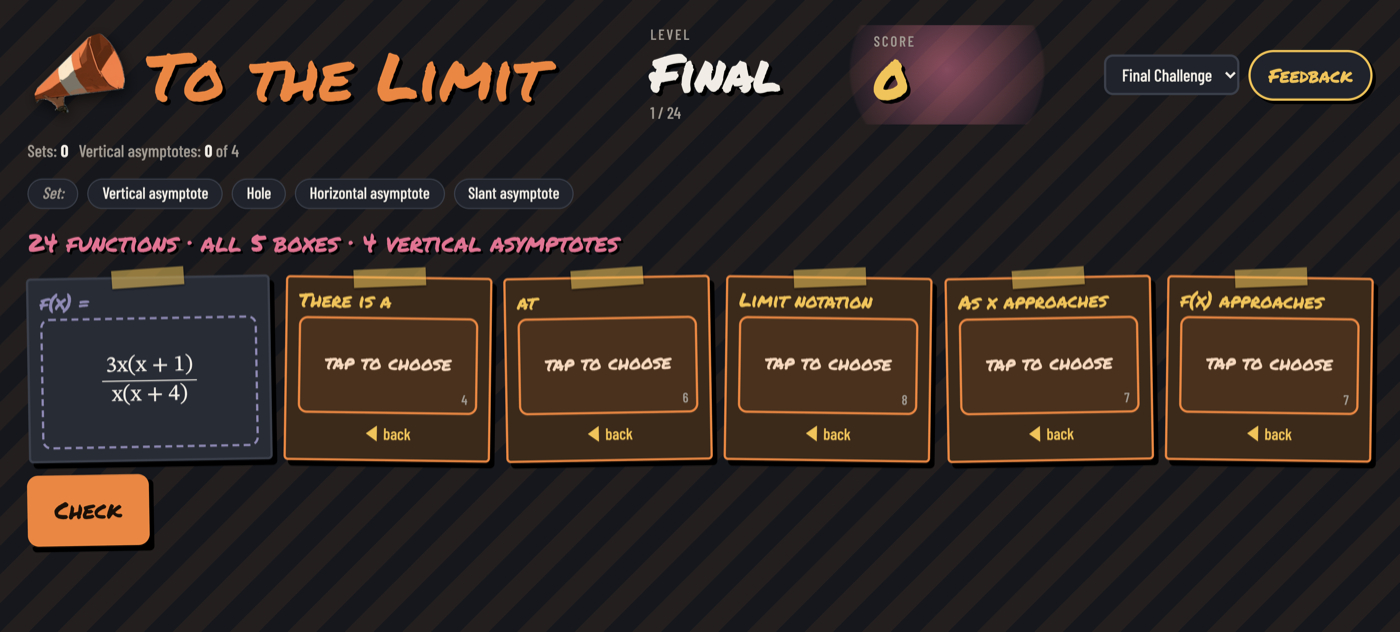
In Leroux’s video example, the phrases in the bank match up one specific way. My content does not work like that: one function can have a hole, a vertical asymptote, and a horizontal asymptote all at once, so there are several true statements a student could build. The game accepts any internally consistent true row. Getting that right forced some of the biggest design changes in the build, because the wrong-answer choices had to be rebuilt from the common mistakes students make instead of drawn from a fixed answer bank.
Easing players in took careful decisions, because I did not want the game to ever hint at the correct answer. One way to make early levels easier is to offer fewer choices in each box, but narrow the choices too far and the box starts giving the answer away. So the levels change how many boxes a student fills instead, and every box keeps enough choices that the student is always deciding for themselves.
Part of good game design is that the game shows you how to play it, so there are no instruction paragraphs on the page. The first time a rule matters, the game says it in as few words as possible: “+1 · first check.” Students figure out the rest by playing.
Design decisions
Leroux’s framework builds the game backwards: you design the final challenge first, then create the practice loops that prepare a player for it. So the first thing I designed was the end state, a completely empty row with no hints, where the game says only “Not yet.” Every level below it is a scaffolded version of that same challenge.
Leroux calls them challenge modifiers; as a teacher I would call it scaffolding. Knowing my students told me where the difficulty would come from. Slant asymptotes take long division while everything else can be read off the function, so they stay out of the game until Level Four. Students also gravitate to the property they are most comfortable with, so from Level Five on, a rule blocks using the same property two rounds in a row, and a bonus rewards using all four. The game starts easy and adds one kind of difficulty at a time.
I wanted the game to be a different experience for each person who plays it, and for the same player every time they come back to it. It draws 24 functions from a bank of 120 every play. Points scale up by level, which also closed a loophole where a student could farm easy points by staying on Level One.
Reflection
One of Leroux’s guiding principles is that the game is the learning, and I kept asking myself whether this game follows it. My students had already learned this information in a different way. But what they had not done is connect the pieces: the function, the property, its location, and the limit notation all describe the same thing, and students often know some of those pieces without the rest. In this game, making those connections is the learning, so it follows the principle.
I have given the game to my students to try. The next update to this page is what happened when they actually played it.